What Is HH+? The Truth Behind the Viral “Secret Hydrogen Compound”
What Is HH+? The Truth Behind the Viral “Secret Hydrogen Compound”
Introduction: Why So Many People Are Searching for HH+
If you’ve searched for HH+, chances are you came across YouTube videos claiming a mysterious powder that can dramatically improve hydrogen production using almost no electricity. The idea sounds exciting — even revolutionary — especially in a world looking for cleaner energy solutions.
But when we take a calm, scientific look at these claims, a different story emerges.
This article explains what HH+ is claimed to be, what science actually says, and why viewers should be cautious about trusting anonymous viral content.
Where Did the HH+ Idea Come From?
The concept of HH+ comes primarily from a small number of YouTube channels promoting a so-called “secret compound” that allegedly enhances electrolysis. The creators suggest this chemical can unlock highly efficient hydrogen production and even imply that energy companies are trying to suppress it.
These videos are designed to feel like you’re being let in on hidden knowledge. Mystery, secrecy, and dramatic storytelling are powerful tools for gaining attention online.
However, none of these videos provide verifiable scientific documentation, independent testing, or transparent proof.
A Simple Scientific Reality Check
When a real chemical breakthrough happens, it usually leaves a trail in credible places, such as:
-
Peer-reviewed scientific journals
-
Chemical compound databases
-
Patent offices
-
University or industry research papers
In the case of HH+, no such records exist.
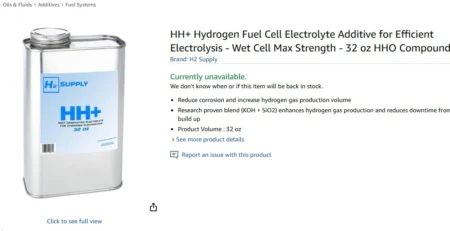
There is no registered chemical compound called HH+ that functions as a hydrogen electrolysis enhancer. There is also no patent, no academic publication, and no recognized manufacturer tied to this substance.
That absence alone is a strong indicator that HH+ — as promoted in viral videos — is not a real invention.
So What Is the Powder in Those Videos?
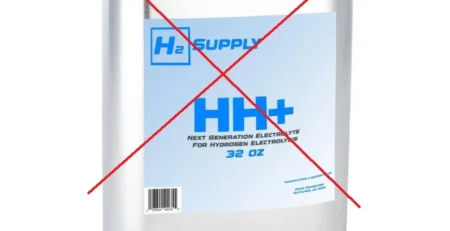
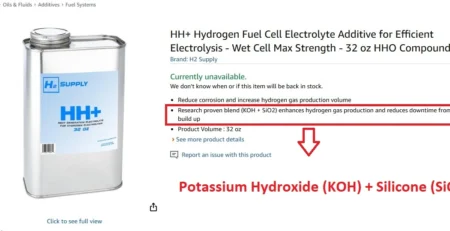
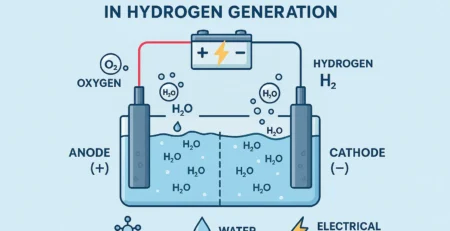
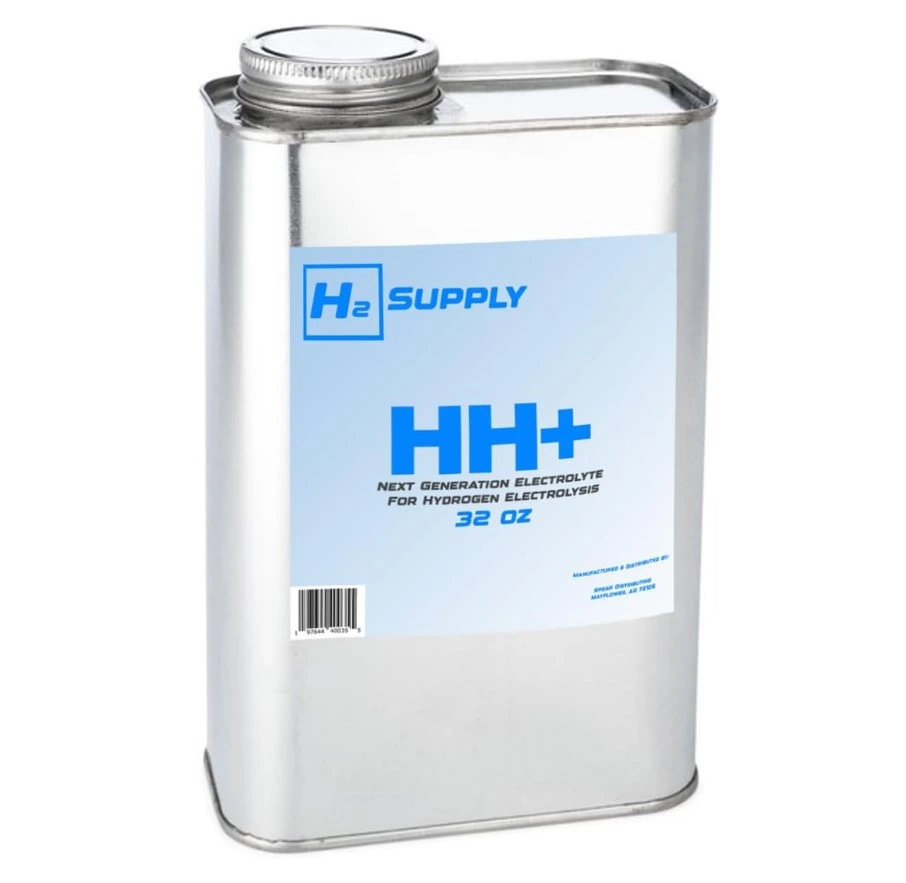
Many viewers notice a white powder being added to water in these demonstrations. While the videos suggest this is a special formula, chemistry professionals widely recognize that the material shown is likely a common electrolyte, such as:
Potassium hydroxide (KOH), which is frequently used in hydrogen electrolysis
Sodium hydroxide (NaOH), another widely known conductivity enhancer
Baking soda (sodium bicarbonate), sometimes used in hobby experiments
In some cases, creators may also add silicone-based anti-foaming agents. These substances reduce bubbling and make reactions appear smoother or more controlled on camera, which can unintentionally — or intentionally — create a more “impressive” visual effect.
None of these materials are secret. They are standard, well-known chemicals used in basic electrochemistry.
Why the Demonstrations Can Look Convincing
Video experiments can be visually persuasive, especially when viewers don’t see the full testing setup.
Small changes in filming angle, electrical measurement methods, editing, or baseline comparisons can dramatically alter how results appear. Without transparent instrumentation and independent replication, it’s impossible to confirm whether a performance improvement is real — or simply the result of presentation techniques.
This doesn’t necessarily mean every creator is malicious, but it does mean visual demonstrations alone are not scientific proof.
The Real Scientific Meaning of HH⁺
Interestingly, HH⁺ does exist in real science, but not in the way these videos suggest.
In physics and chemistry, HH⁺ (more commonly written as H₂⁺) refers to the dihydrogen cation, a molecular ion made of two hydrogen nuclei sharing one electron. It is studied in quantum mechanics, astrophysics, and molecular spectroscopy.
You can find this HH⁺ in:
-
Academic physics research
-
Studies of interstellar space
-
Laboratory ion experiments
What you won’t find is any link between this legitimate scientific ion and a commercial powder that boosts hydrogen fuel efficiency.
The viral “HH+ compound” is not connected to this real scientific concept.
Why People Are Drawn to These Claims
It’s completely understandable that people feel excited about the idea of a hidden energy breakthrough. Many of us want:
-
Cleaner fuel
-
Lower energy costs
-
Innovative technology that helps the planet
Some creators tap into this optimism, combining it with mystery and conspiracy-style storytelling. This can make viewers feel like they’re discovering something powerful or forbidden.
But science doesn’t progress through secrecy — it progresses through open testing, peer review, and reproducibility.
What Real Hydrogen Innovation Looks Like
Legitimate improvements in hydrogen production come from areas such as:
-
Better electrode materials
-
Smarter power control systems
-
Improved cell design
-
Temperature and efficiency optimization
-
Verified industrial research
These advancements are measurable, published, and replicable — not hidden behind anonymous videos.
A Friendly Word of Caution for Viewers
YouTube can be an amazing place to learn, but it’s also a place where entertainment sometimes looks like science.
Before believing technical claims online, it helps to ask:
-
Can this be independently verified?
-
Are the creators transparent about who they are?
-
Is there scientific literature supporting the claim?
-
Could there be a simpler explanation?
Being curious is a great thing. Pairing curiosity with critical thinking is even better.
Conclusion: Stay Curious — But Don’t Believe Everything You See Online
HH+ — as promoted in viral hydrogen videos — is not supported by scientific evidence. The powder shown is almost certainly ordinary, well-known chemicals, presented in a way that creates an illusion of a breakthrough.
That doesn’t mean innovation isn’t happening in hydrogen technology — it absolutely is. But real innovation leaves a public scientific footprint, not just a trail of mysterious videos.
So enjoy exploring new ideas, stay excited about clean energy, and keep learning — just remember that not everything on YouTube reflects reality, especially when the creators stay hidden and the evidence stays unclear.
Scientific References
-
PubChem Compound Database
-
American Chemical Society (ACS) Publications
-
Journal of Electrochemical Science and Engineering
-
NASA Astrophysics Data System (H₂⁺ Ion Studies)
-
USPTO & WIPO Patent Databases
-
Fundamentals of Electrolysis — Electrochemical Society
Subscribe our Newsletter