HH+ for Sale: Why This “Breakthrough” Is a Total Scam
HH+ for Sale: Why This “Breakthrough” Is a Total Scam
When Curiosity Turns Into Exploitation
The phrase “HH+ for sale” suggests a revolutionary chemical that can improve hydrogen production efficiency. Many people searching for this product genuinely believe they’re on the verge of discovering a cutting-edge energy breakthrough.
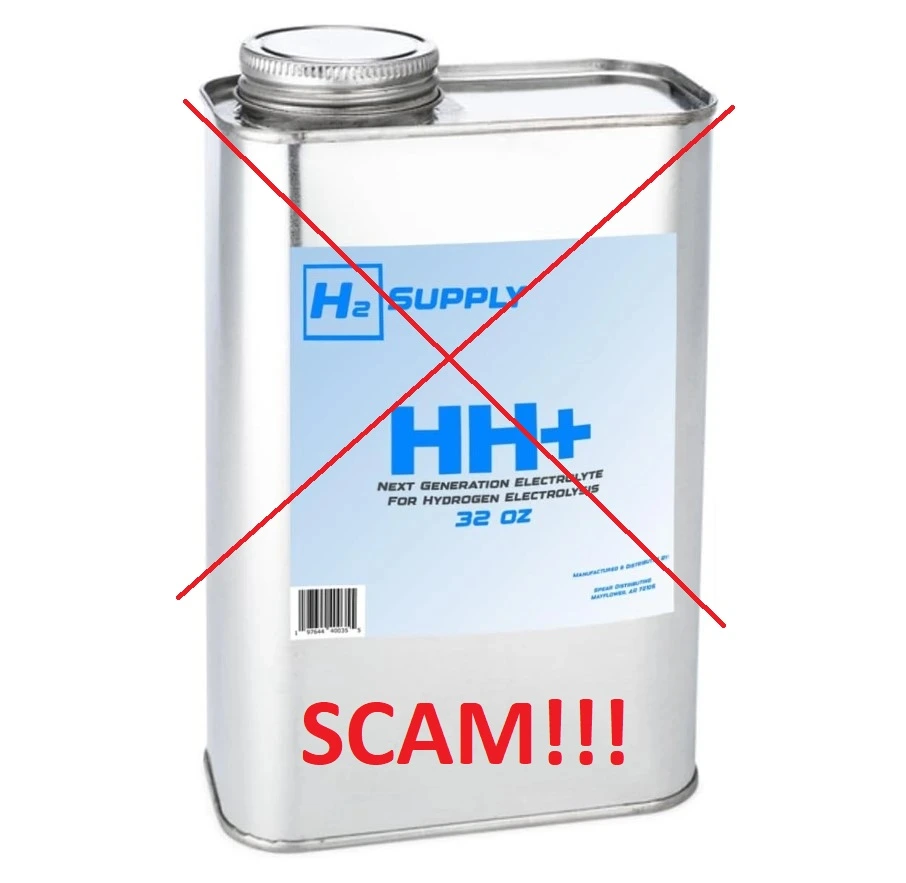
Unfortunately, HH+ is not a breakthrough — it is a fabricated product built on deception.
This article explains why HH+ is a scam, what is actually being sold under this name, and how thousands of viewers were persuaded to believe in something that has no scientific basis.
The Origin of the HH+ Scam
HH+ became popular after a series of YouTube videos claimed to reveal a secret chemical additive capable of producing large volumes of hydrogen using minimal electrical energy.
The creators behind these videos:
-
Never revealed their identities
-
Never published scientific data
-
Never allowed independent testing
-
Never disclosed a real chemical formula
Instead, they built an illusion of secrecy, implying that the technology was too powerful or disruptive for the energy industry to accept.
This is a classic scam pattern: create mystery, promise hidden knowledge, and monetize curiosity.

Why HH+ Is Not a Real Product
In legitimate science, a real chemical innovation would leave clear evidence, including:
-
Peer-reviewed publications
-
Patent filings
-
Chemical registry entries
-
Replicated laboratory tests
-
Independent scientific validation
HH+ has none of these.
There is no recognized compound called HH+ in PubChem, CAS, Google Patents, or any academic chemistry archive. There are also no verified researchers, institutions, or companies claiming authorship of this invention.
That absence is not accidental — it’s proof that HH+ does not exist as a genuine chemical discovery.
What Is Actually Being Sold as HH+
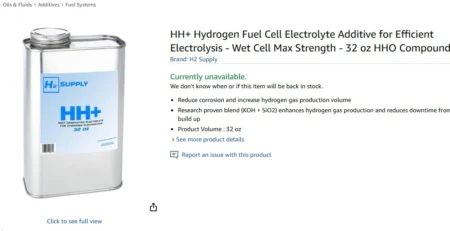
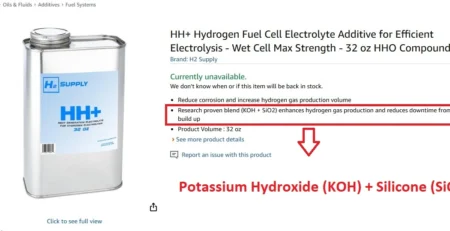
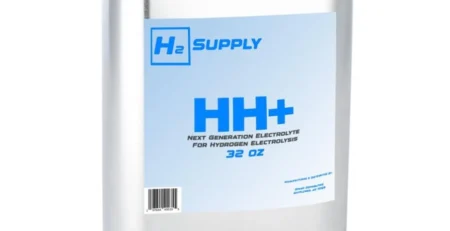
Products marketed as HH+ are almost always ordinary electrolytes, repackaged and rebranded to appear innovative.
Based on chemistry knowledge and material analysis, these typically include common substances such as potassium hydroxide, sodium hydroxide, or sodium bicarbonate. These materials are widely used in electrolysis and cost very little on the industrial market.
In some demonstrations, silicone-based anti-foaming agents are added. These additives do not improve hydrogen efficiency — they simply make reactions look cleaner and more impressive on camera.
In other words, buyers are paying premium prices for cheap, everyday chemicals dressed up as a scientific miracle.
How Viewers Were Convinced It Was Special
Many viewers sincerely believed HH+ was revolutionary because the videos were designed to look convincing.
The creators used:
-
Carefully staged demonstrations
-
Selective camera angles
-
Edited performance comparisons
-
Emotional storytelling about hidden technology
-
Claims of industry suppression
Without full measurement transparency or independent verification, it’s easy to assume that dramatic visual results must come from a special compound.
This was not accidental — it was intentional manipulation.
Why This Qualifies as a Scam
A product qualifies as a scam when it:
-
Claims scientific capabilities it cannot prove
-
Refuses to disclose composition or testing data
-
Uses misleading demonstrations
-
Exploits public trust and curiosity
-
Sells ordinary materials as revolutionary
HH+ fits all of these criteria.
People searching for clean energy solutions were not given real innovation — they were given a story designed to generate views, attention, and profit.
The Real Science of Hydrogen Efficiency
Improving hydrogen production efficiency is a legitimate scientific goal — but real progress comes from engineering, not secret powders.
Actual advancements involve improvements in electrode materials, power electronics, thermal control, and system design. These improvements are documented in scientific literature and validated through repeatable experiments.
If a simple powder could create massive efficiency gains, it would already be known across universities, laboratories, and industry research centers worldwide.
It is not hidden — because it does not exist.
Why It’s Important to Call This Out Clearly
Calling HH+ a scam is not about attacking curiosity. It’s about protecting people from being misled.
Many viewers trusted the creators because they wanted to believe in technological progress. That trust was used against them.
Recognizing deception helps prevent future misinformation — and encourages people to rely on real science instead of viral spectacle.
Conclusion: Be Inspired by Innovation — But Don’t Trust Anonymous YouTube “Breakthroughs”
HH+ for sale is not an opportunity — it is a marketing scam built on false scientific claims.
The people who promoted it created an illusion of secret knowledge while offering nothing more than common chemicals and dramatic storytelling.
It’s absolutely fine to feel excited about clean energy innovation — but it’s wise to remember that real scientific breakthroughs are published, verifiable, and transparent.
As a rule of thumb:
If a YouTube creator hides their identity, refuses independent testing, and promises a miracle — don’t treat it as science, because it is a pure Scam!
Subscribe our Newsletter