
What is HHO Gas? A Beginner’s Guide to Oxyhydrogen Technology
What is HHO Gas? – Introduction
You may have heard of HHO gas or oxyhydrogen in discussions about clean energy and fuel-saving devices. But what exactly is it?
In this article, we’ll break it down in simple terms. You’ll learn how HHO gas is produced, how it works, and why it’s gaining popularity in transportation and industrial use.
Whether you’re a mechanic, fleet owner, or just curious about hydrogen technology, this guide is for you.
HHO gas, also known as oxyhydrogen, is a mixture of two parts hydrogen (H₂) and one part oxygen (O₂)—the same elements found in water (H₂O).
When water is split using electricity (a process called electrolysis), these gases are released. Instead of being stored separately like in traditional hydrogen systems, they’re used together as a combined fuel source.
This gas mixture is:
-
Highly flammable
-
Clean-burning
-
Safe when produced on demand
That’s why many systems, like ours at Hydrox Systems, generate HHO only when needed—making it safe for automotive and industrial applications.
How HHO Gas Is Made
HHO gas is made by passing an electrical current through water in an electrolyzer. The basic components include:
-
Water tank (preferably with distilled water)
-
Electrodes (usually stainless steel)
-
Power supply (from a vehicle or external source)
-
PWM controller (for current and temperature control)
The reaction looks like this:
2H₂O → 2H₂ + O₂
This gas is then directed into an engine’s air intake or combustion chamber, where it enhances the burning of traditional fuel like diesel or gasoline.
Benefits of HHO Gas in Vehicles
Adding HHO to a fuel system helps engines burn fuel more completely. This can bring several advantages:
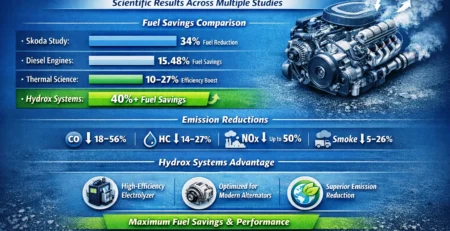
✅ Better fuel efficiency — Save up to 15–30% on fuel, depending on the system and engine type
✅ Lower emissions — Reduce harmful gases like CO₂, NOx, and unburned hydrocarbons
✅ Cleaner engine internals — Less carbon buildup in parts like injectors, EGRs, and manifolds
✅ Longer engine life — Smoother combustion means less wear and tear
✅ Safe integration — HHO systems don’t modify the engine; they work alongside it
Fleet managers, trucking companies, and even private vehicle owners are turning to HHO systems for these benefits.
Oxyhydrogen vs. Hydrogen: What’s the Difference?
People often confuse HHO gas with pure hydrogen (H₂). Here’s how they differ:
| Feature | HHO (Oxyhydrogen) | Hydrogen |
|---|---|---|
| Composition | H₂ + O₂ (2:1 mix) | Only H₂ |
| Storage | Generated on demand | Needs high-pressure tanks |
| Safety | Lower risk (no storage) | Risk of leaks & explosions |
| Usage | Combustion support | Fuel cells or combustion |
| Applications | Engines, welding, cleaning | EVs, industry, fuel cells |
In short: HHO is more practical for retrofitting existing vehicles or machines, while pure hydrogen is better suited for larger-scale infrastructure projects.
Where Is HHO Used?
HHO gas is versatile. You’ll find it in:
-
Cars and trucks (to save fuel and reduce emissions)
-
Buses and fleets (for compliance and cost savings)
-
Marine vessels (to improve engine performance)
-
Welding and cutting (as a high-temperature flame source)
-
Industrial boilers (for cleaner combustion)
-
Hydrogen engine cleaning machines (removing carbon buildup)
Hydrox Systems provides solutions for all of these sectors, including plug-and-play hydrogen generators and full fleet conversion kits.
Is HHO Gas Safe?
Yes—when used correctly.
Unlike hydrogen tanks, HHO is never stored, only produced on demand. This minimizes explosion risks. Plus, HHO systems are designed with:
-
Safety valves
-
Water level sensors
-
Temperature protection
-
Electrical shut-offs
Always choose certified equipment from reputable companies like Hydrox Systems for reliable performance.
The Future of HHO Technology
As the world looks for alternatives to fossil fuels, HHO technology is gaining attention for its affordability, accessibility, and results.
While pure hydrogen and electric vehicles are growing in popularity, they require massive infrastructure changes. HHO systems, on the other hand, work with what we already have—internal combustion engines.
They offer a bridge solution for companies that want to decarbonize affordably and save fuel now, without waiting for future technologies.
Final Thoughts
HHO gas is more than just science—it’s a practical solution that helps reduce emissions and fuel costs today.
At Hydrox Systems, we’re helping businesses and individuals adopt clean hydrogen solutions through advanced HHO technology. If you’re ready to explore the benefits, contact us or browse our range of hydrogen generators.
Subscribe our Newsletter